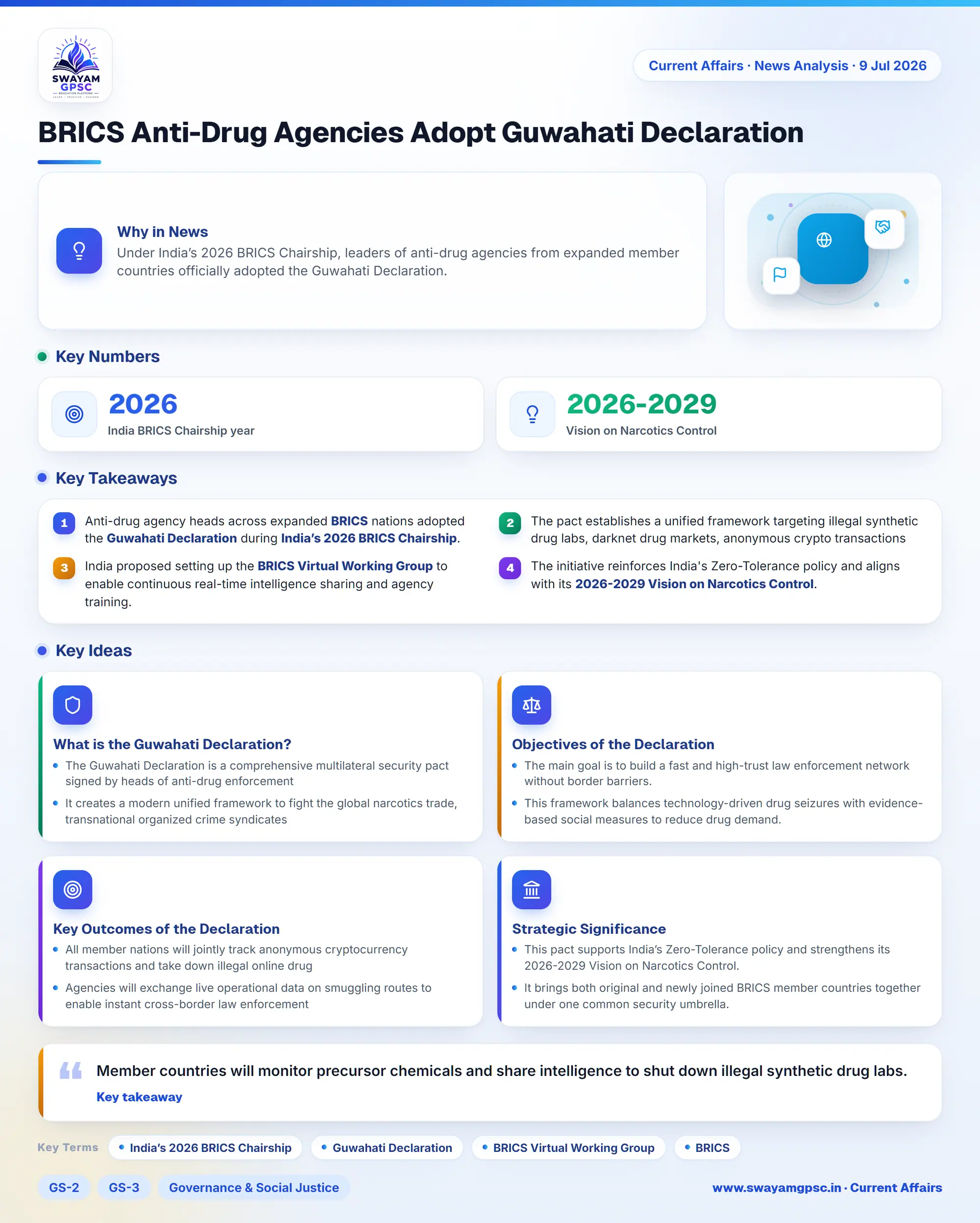
BRICS Anti-Drug Agencies Adopt Guwahati Declaration
#GS-2 #GS-3 #Governance & Social Justice #Current Events #International #Cyber Security #BRICS #Guwahati Declaration #Narcotics Control
Key takeaways
- Anti-drug agency heads across expanded BRICS nations adopted the Guwahati Declaration during India’s 2026 BRICS Chairship.
- The pact establishes a unified framework targeting illegal synthetic drug labs, darknet drug markets, anonymous crypto transactions, and money laundering.
- India proposed setting up the BRICS Virtual Working Group to enable continuous real-time intelligence sharing and agency training.
- The initiative reinforces India's Zero-Tolerance policy and aligns with its 2026-2029 Vision on Narcotics Control.
Why in News
- Under India’s 2026 BRICS Chairship, leaders of anti-drug agencies from expanded member countries officially adopted the Guwahati Declaration.
What is the Guwahati Declaration?
- The Guwahati Declaration is a comprehensive multilateral security pact signed by heads of anti-drug enforcement agencies across expanded BRICS nations.
- It creates a modern unified framework to fight the global narcotics trade, transnational organized crime syndicates, and financial tracking vulnerabilities enabling money laundering.
Objectives of the Declaration
- The main goal is to build a fast and high-trust law enforcement network without border barriers.
- This framework balances technology-driven drug seizures with evidence-based social measures to reduce drug demand.
Key Outcomes of the Declaration
- Member countries will monitor precursor chemicals and share intelligence to shut down illegal synthetic drug labs.
- All member nations will jointly track anonymous cryptocurrency transactions and take down illegal online drug marketplaces on the darknet.
- Agencies will exchange live operational data on smuggling routes to enable instant cross-border law enforcement actions.
- India proposed a digital platform called the BRICS Virtual Working Group to support continuous information sharing and agency training.
- The agreement balances strict enforcement with public health through drug rehabilitation, medical treatment, and youth awareness drives.
Strategic Significance
- This pact supports India’s Zero-Tolerance policy and strengthens its 2026-2029 Vision on Narcotics Control.
- It brings both original and newly joined BRICS member countries together under one common security umbrella.
- Joint naval surveillance will protect key shipping routes against massive drug smuggling operations by international cartels.