Cardiff Pact and Challenges to UK Federalism
#GS-2 #Indian Polity & Constitution #Constitution #Federalism #Governance & Social Justice #Current Events #International
Key takeaways
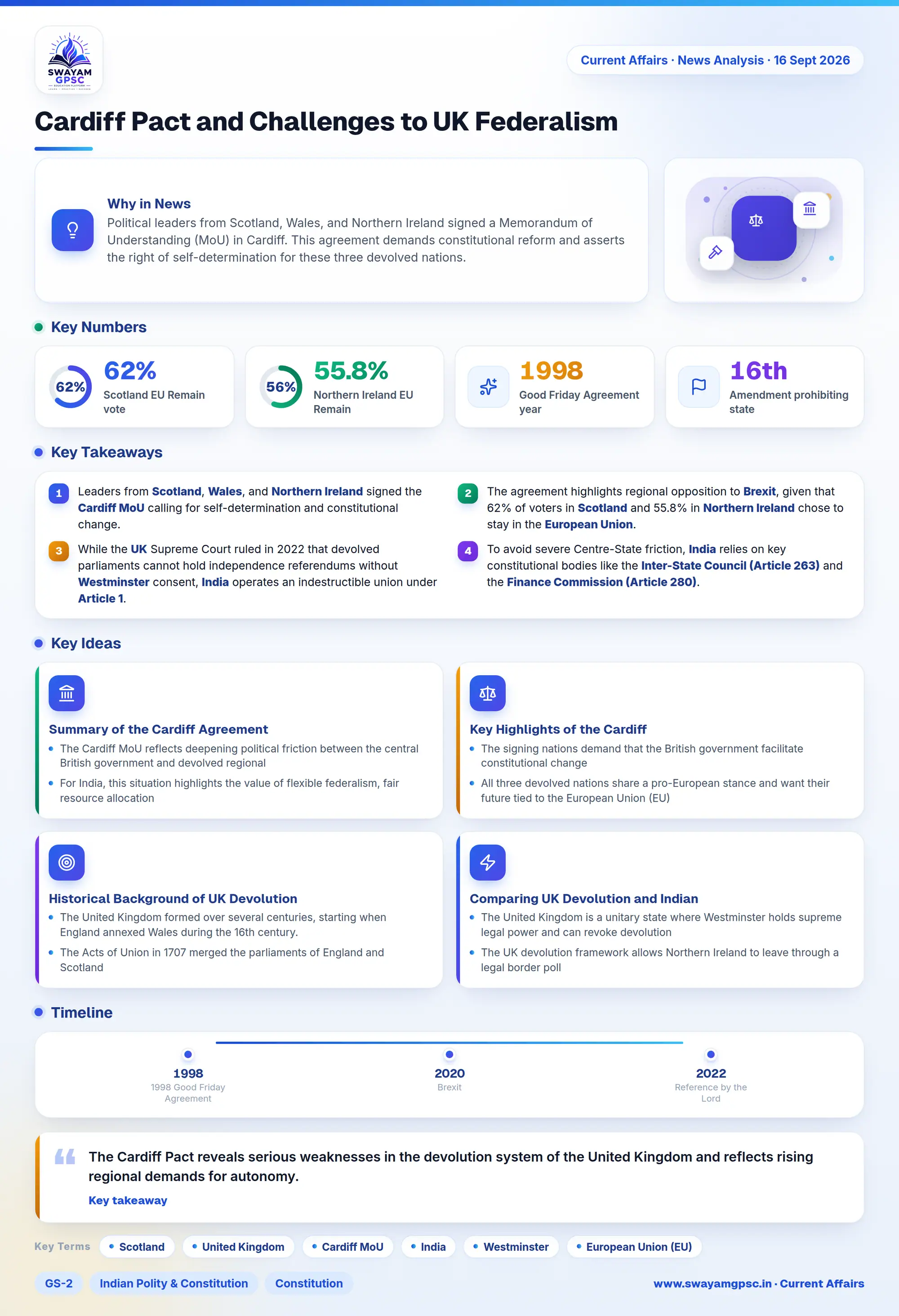
- Leaders from Scotland, Wales, and Northern Ireland signed the Cardiff MoU calling for self-determination and constitutional change.
- The agreement highlights regional opposition to Brexit, given that 62% of voters in Scotland and 55.8% in Northern Ireland chose to stay in the European Union.
- While the UK Supreme Court ruled in 2022 that devolved parliaments cannot hold independence referendums without Westminster consent, India operates an indestructible union under Article 1.
- To avoid severe Centre-State friction, India relies on key constitutional bodies like the Inter-State Council (Article 263) and the Finance Commission (Article 280).
Why in News
- Political leaders from Scotland, Wales, and Northern Ireland signed a Memorandum of Understanding (MoU) in Cardiff.
- This agreement demands constitutional reform and asserts the right of self-determination for these three devolved nations.
- The pact has restarted intense debates over the devolution structure of the United Kingdom as regional autonomy demands grow.
Summary of the Cardiff Agreement
- The Cardiff MoU reflects deepening political friction between the central British government and devolved regional governments.
- For India, this situation highlights the value of flexible federalism, fair resource allocation, and continuous political dialogue.
Key Highlights of the Cardiff Memorandum of Understanding
- The signing nations demand that the British government facilitate constitutional change, stating that central control from Westminster must end.
- All three devolved nations share a pro-European stance and want their future tied to the European Union (EU), rejecting the nationwide Brexit decision.
- Beyond calling for independence votes, the agreement commits Scotland, Wales, and Northern Ireland to direct economic and energy cooperation.
- The United Kingdom government rejected the agreement and declared that independence referendums remain strictly forbidden.
- Central authorities cited the 2022 supreme court ruling in Reference by the Lord Advocate, which affirmed that devolved parliaments cannot legally hold independence votes without consent.
- Under the 1998 Good Friday Agreement, the British government can order a border poll on Irish reunification, but officials state current support levels remain insufficient.
Historical Background of UK Devolution
- The United Kingdom formed over several centuries, starting when England annexed Wales during the 16th century.
- The Acts of Union in 1707 merged the parliaments of England and Scotland, while Ireland joined in 1801 before its 1920 partition left Northern Ireland in the UK.
- Modern devolution began in the late 1990s through the Scotland Act (1998), which created a Scottish Parliament with local legislative powers.
- The 1998 Good Friday Agreement established a shared government in Northern Ireland and allowed a future border poll on Irish unification.
- The Government of Wales Act (1998) created the Welsh Senedd to manage regional administration.
- Tensions escalated because Brexit in 2020 removed Scotland (62% voted to remain in the EU) and Northern Ireland (55.8% voted to remain) against their democratic choices.
- Central laws like the UK Internal Market Act 2020 led regional leaders to accuse Westminster of taking power back from local parliaments.
- Combined with financial strain under the outdated Barnett Formula, regional leaders view central policies as centralist coercion, directly triggering the Cardiff MoU.
Comparing UK Devolution and Indian Federalism
- The United Kingdom is a unitary state where Westminster holds supreme legal power and can revoke devolution, while India is an indestructible Union of States under Article 1.
- The UK devolution framework allows Northern Ireland to leave through a legal border poll, whereas Indian states have no constitutional right to secede, strengthened by the 16th Constitutional Amendment, 1963.
- The UK uses ad-hoc devolution with varying regional powers, while India follows constitutional asymmetric federalism under Articles 371 to 371-J and the 5th and 6th Schedules.
- The UK relies on an unwritten constitution with power granted by central acts, whereas India relies on a written Constitution dividing powers across the Union, State, and Concurrent Lists in the 7th Schedule.
- The Supreme Court of India serves as an independent federal umpire under Article 131 to settle disputes between the Centre and States.
Strategic and Federal Lessons for India
- The UK experience proves that ignoring regional identities feeds separatism, whereas India maintains stability by respecting cultural diversity through measures like the States Reorganisation Act (1956).
- India must actively use consultative forums like the Inter-State Council (Article 263), the NITI Aayog Governing Council, and Zonal Councils to resolve disputes early.
- Fair resource distribution through the Finance Commission (Article 280) is crucial to ensure that economically strong states do not feel financially alienated.
- Flexible constitutional arrangements, such as Article 371 protecting tribal customs in Northeast India, help balance regional identity with national unity.
- The upcoming delimitation process must protect regional representation so that states that effectively controlled population growth are not politically penalised.
- A geopolitically weakened United Kingdom allows emerging nations like India to claim larger global roles, including a permanent seat on the UN Security Council (UNSC).
Conclusion
- The Cardiff Pact reveals serious weaknesses in the devolution system of the United Kingdom and reflects rising regional demands for autonomy.
- For India, maintaining national unity requires continuous democratic consultation, equitable fiscal federalism, and flexible constitutional protections.