Dedicated Freight Corridors of India
#GS-3 #Economy #Infrastructure
Key takeaways
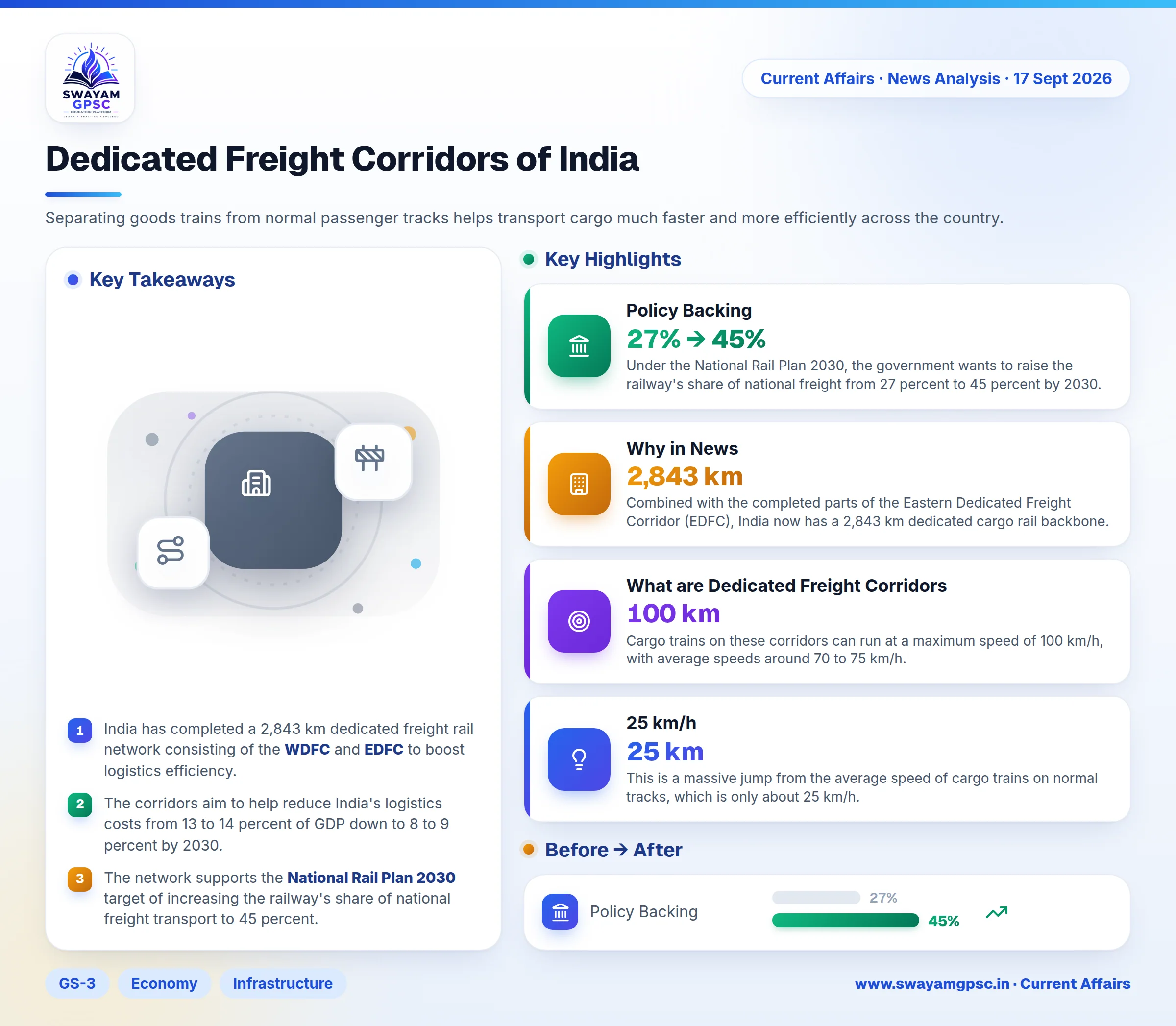
- India has completed a 2,843 km dedicated freight rail network consisting of the WDFC and EDFC to boost logistics efficiency.
- The corridors aim to help reduce India's logistics costs from 13 to 14 percent of GDP down to 8 to 9 percent by 2030.
- The network supports the National Rail Plan 2030 target of increasing the railway's share of national freight transport to 45 percent.
- Fully electric operations on these routes are projected to save over 450 million tonnes of carbon dioxide emissions over the next 30 years.
Why in News
- The Western Dedicated Freight Corridor (WDFC) is now fully operational, marking a massive milestone for India's transport infrastructure.
- Combined with the completed parts of the Eastern Dedicated Freight Corridor (EDFC), India now has a 2,843 km dedicated cargo rail backbone.
- This large network strengthens the logistics plans created under the PM GatiShakti National Master Plan.
What are Dedicated Freight Corridors
- Dedicated Freight Corridors (DFCs) are special broad-gauge railway tracks built only for cargo trains in India.
- Separating goods trains from normal passenger tracks helps transport cargo much faster and more efficiently across the country.
- Cargo trains on these corridors can run at a maximum speed of 100 km/h, with average speeds around 70 to 75 km/h.
- This is a massive jump from the average speed of cargo trains on normal tracks, which is only about 25 km/h.
Implementation Agency
- The Dedicated Freight Corridor Corporation of India Limited (DFCCIL) is the main agency building and running these routes.
- This public sector company works under the Ministry of Railways and was set up as a Special Purpose Vehicle.
- The company handles the planning, building, running, and upkeep of all dedicated freight tracks in India.
India's DFC Corridors and their Status
- The completed 2,843 km network has two main parts.
- The WDFC spans 1,506 km and connects Dadri in Uttar Pradesh to the Jawaharlal Nehru Port Trust (JNPT) in Mumbai.
- The EDFC covers 1,337 km and links Ludhiana in Punjab to Sonnagar in Bihar.
- The remaining 519 km stretch from Sonnagar to Dankuni in West Bengal will be built later using a Public-Private Partnership model.
Proposed Corridors
- The government plans to build the East-West Corridor from Dankuni in West Bengal to Surat and Palghar in Maharashtra.
- This route will connect the mineral-rich eastern states directly to busy ports in Gujarat.
- The proposed East Coast Corridor will run from Kharagpur in West Bengal to Vijayawada in Andhra Pradesh.
- The North-South Corridor will connect Itarsi in Madhya Pradesh to Vijayawada in Andhra Pradesh through Nagpur.
Policy Backing
- These corridors work closely with the PM GatiShakti National Master Plan by linking ports, factories, and logistics parks.
- They support the National Logistics Policy (NLP) 2022, which aims to cut India's logistics costs from 13 to 14 percent down to 8 to 9 percent of GDP by 2030.
- The policy also aims to place India among the top 10 nations in the global Logistics Performance Index (LPI) by 2030.
- These routes connect with the Sagarmala Project to improve the final links between ports and railways.
- Under the National Rail Plan 2030, the government wants to raise the railway's share of national freight from 27 percent to 45 percent by 2030.
Significance of DFCs for the Indian Economy
- High logistics costs of 13 to 14 percent of GDP make Indian exports expensive. DFCs lower these costs by using double-stack containers and carrying heavier 25 tonne axle loads.
- Moving about 70 percent of cargo traffic to these new tracks frees up normal railway lines. This allows passenger trains to run on time and helps introduce faster trains like the Vande Bharat.
- These corridors run next to major industrial projects like the Delhi-Mumbai Industrial Corridor (DMIC) and the Amritsar-Kolkata Industrial Corridor.
- They help set up new multi-modal parks, industrial townships, and PM MITRA textile parks along the way.
- Since these routes are fully electric, they will save more than 450 million tonnes of carbon emissions over 30 years. This supports India's goal of reaching Net Zero by 2070.
- Connecting inland areas to major western ports like JNPT cuts travel times. For example, the trip from Dadri to JNPT dropped from 66 hours to 58 hours, helping industries meet global deadlines.
Challenges
- The corridors must connect with 7 High-Density Networks (HDNs), which are already overloaded and carry over 40 percent of all rail traffic.
- Many HDN routes run at more than 150 percent of their capacity, causing delays when cargo trains switch to normal tracks.
- Poor local roads and rail links between factories and DFC stations create a last-mile gap that wastes the time saved on high-speed lines.
- Cargo mostly moves from north to west for exports, leaving returning trains empty and hurting the financial health of these corridors.
- Delays in acquiring land across different states led to court cases, which increased overall project costs.
- DFC tracks are built for heavier axle loads than normal tracks, creating operational issues when trains move between the two systems.
- While the World Bank and the Japan International Cooperation Agency (JICA) funded early phases, raising huge funds for future corridors remains a challenge.
- Many cargo terminals lack cold storage and cooling facilities, making it hard to transport medicines and fresh food safely.
Way Forward
- India needs to add more tracks to busy HDN sections quickly. This will help meet the National Rail Plan goal of raising freight loading to 3,000 MT by 2030.
- Using the GIS-based planning under PM GatiShakti can help connect DFC stations with feeder roads and industrial parks.
- Adding smart tracking tools like RFID and IoT sensors will give businesses real-time updates on their cargo.
- Running Roll-on/Roll-off services and offering lower rates for return trips can help fill empty trains heading back from ports.
- Bringing in private companies through Public-Private Partnerships can help build modern terminals and buy specialized wagons.