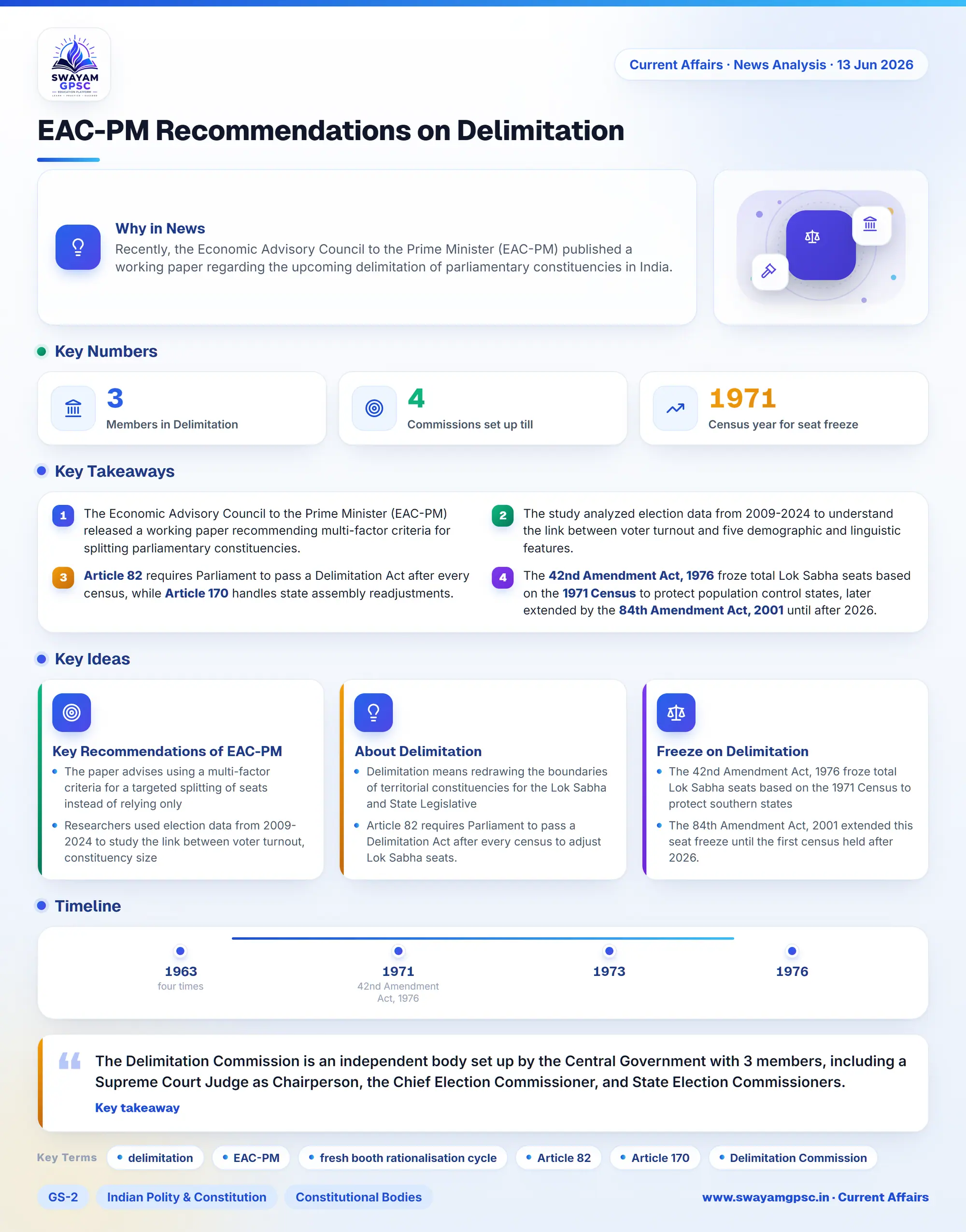
EAC-PM Recommendations on Delimitation
#GS-2 #Indian Polity & Constitution #Constitutional Bodies #Parliament #Current Events #National #Economy
Key takeaways
- The Economic Advisory Council to the Prime Minister (EAC-PM) released a working paper recommending multi-factor criteria for splitting parliamentary constituencies.
- The study analyzed election data from 2009-2024 to understand the link between voter turnout and five demographic and linguistic features.
- Article 82 requires Parliament to pass a Delimitation Act after every census, while Article 170 handles state assembly readjustments.
- The 42nd Amendment Act, 1976 froze total Lok Sabha seats based on the 1971 Census to protect population control states, later extended by the 84th Amendment Act, 2001 until after 2026.
Why in News
- Recently, the Economic Advisory Council to the Prime Minister (EAC-PM) published a working paper regarding the upcoming delimitation of parliamentary constituencies in India.
Key Recommendations of EAC-PM
- The paper advises using a multi-factor criteria for a targeted splitting of seats instead of relying only on population distribution while keeping the current share of Lok Sabha seats for large states safe.
- Researchers used election data from 2009-2024 to study the link between voter turnout, constituency size, and five compositional factors.
- These five factors include urban share, SC share, ST share, linguistic polarisation, and linguistic diversity.
- The EAC-PM suggests that the Delimitation Commission should use demographic and linguistic profiles rather than a single uniform rule for splitting seats.
- Delimitation should happen alongside a fresh booth rationalisation cycle, the release of 2027 Census data, and gender-disaggregated electoral statistics to maintain accuracy.
About Delimitation
- Delimitation means redrawing the boundaries of territorial constituencies for the Lok Sabha and State Legislative Assemblies so every seat represents a similar number of voters.
- Article 82 requires Parliament to pass a Delimitation Act after every census to adjust Lok Sabha seats.
- Article 170 provides similar rules for adjusting seats and constituencies in State Legislative Assemblies.
- The Delimitation Commission is an independent body set up by the Central Government with 3 members, including a Supreme Court Judge as Chairperson, the Chief Election Commissioner, and State Election Commissioners.
- Orders from the Commission carry the force of law and cannot be challenged in any court.
- The Delimitation Commission has been set up four times up to March 2026, which were in 1952, 1963, 1973, and 2002.
Freeze on Delimitation
- The 42nd Amendment Act, 1976 froze total Lok Sabha seats based on the 1971 Census to protect southern states that implemented successful population control policies.
- The 84th Amendment Act, 2001 extended this seat freeze until the first census held after 2026.
- The 2002 Commission redrew internal boundaries inside states using the 2001 Census, but seat distribution between different states still relies on 1971 data.