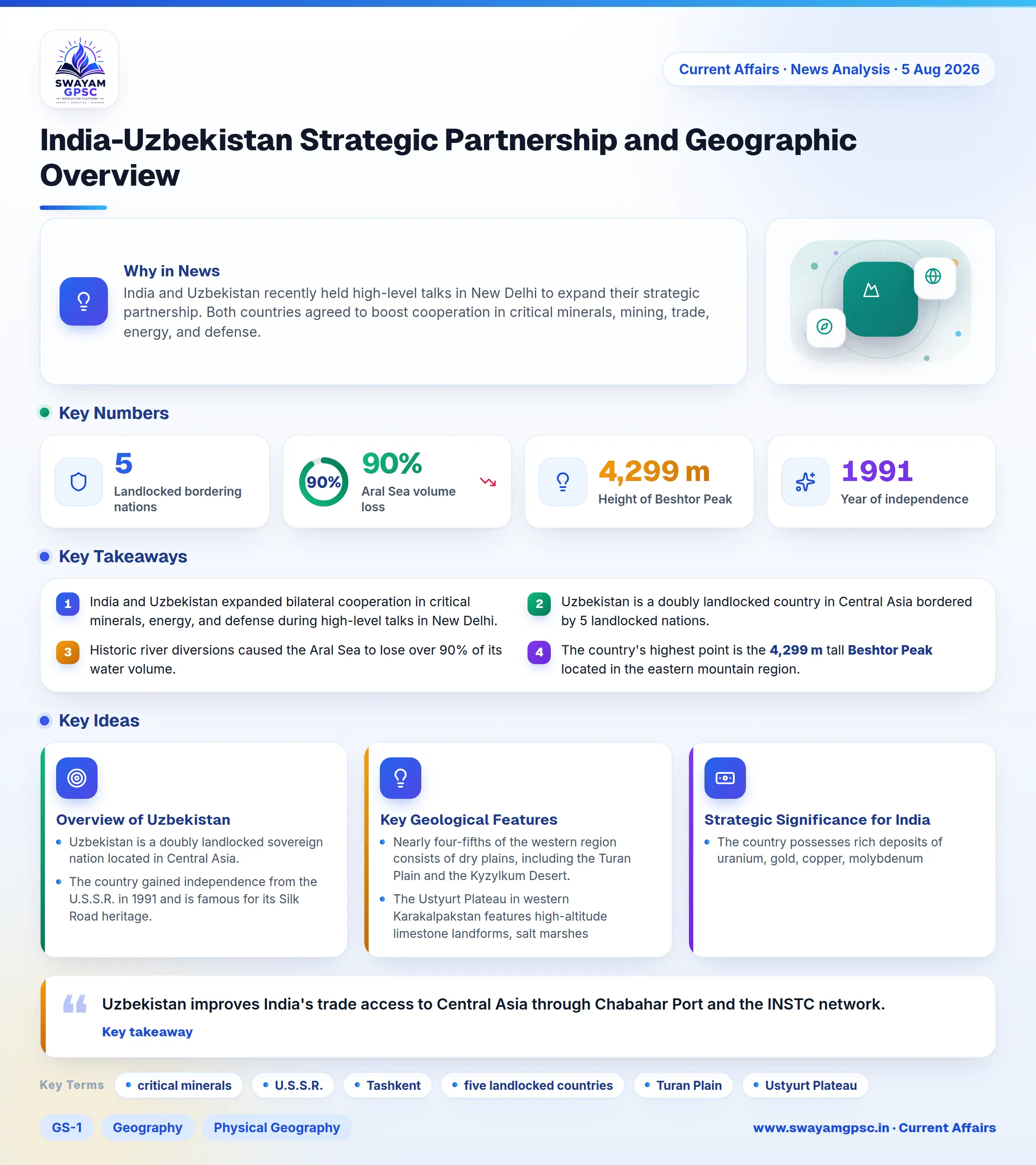
India-Uzbekistan Strategic Partnership and Geographic Overview
#GS-1 #Geography #Physical Geography #Resources #GS-3 #Current Events #International #International Relations #Central Asia #Critical Minerals #INSTC
Key takeaways
- India and Uzbekistan expanded bilateral cooperation in critical minerals, energy, and defense during high-level talks in New Delhi.
- Uzbekistan is a doubly landlocked country in Central Asia bordered by 5 landlocked nations.
- Historic river diversions caused the Aral Sea to lose over 90% of its water volume.
- The country's highest point is the 4,299 m tall Beshtor Peak located in the eastern mountain region.
- Uzbekistan offers India vital connectivity via the INSTC and Chabahar Port routes.
Why in News
- India and Uzbekistan recently held high-level talks in New Delhi to expand their strategic partnership.
- Both countries agreed to boost cooperation in critical minerals, mining, trade, energy, and defense.
Overview of Uzbekistan
- Uzbekistan is a doubly landlocked sovereign nation located in Central Asia.
- The country gained independence from the U.S.S.R. in 1991 and is famous for its Silk Road heritage.
- Its capital city is Tashkent, and the nation lies between the Amu Darya and Syr Darya rivers.
- It shares borders with five landlocked countries: Kazakhstan, Kyrgyzstan, Tajikistan, Afghanistan, and Turkmenistan.
Key Geological Features
- Nearly four-fifths of the western region consists of dry plains, including the Turan Plain and the Kyzylkum Desert.
- The Ustyurt Plateau in western Karakalpakstan features high-altitude limestone landforms, salt marshes, and steep cliffs.
- The eastern region houses rugged mountains, including Beshtor Peak at 4,299 m, which is the country's highest point.
- The Aral Sea Basin lost over 90% of its volume due to past river diversions, creating the Aralkum saline desert.
- The fertile Zeravshan Valley and Fergana Valley support most of the nation's agriculture, population, and historic cities like Samarkand.
Strategic Significance for India
- Uzbekistan improves India's trade access to Central Asia through Chabahar Port and the INSTC network.
- The country possesses rich deposits of uranium, gold, copper, molybdenum, and rare earth elements for clean energy supply chains.