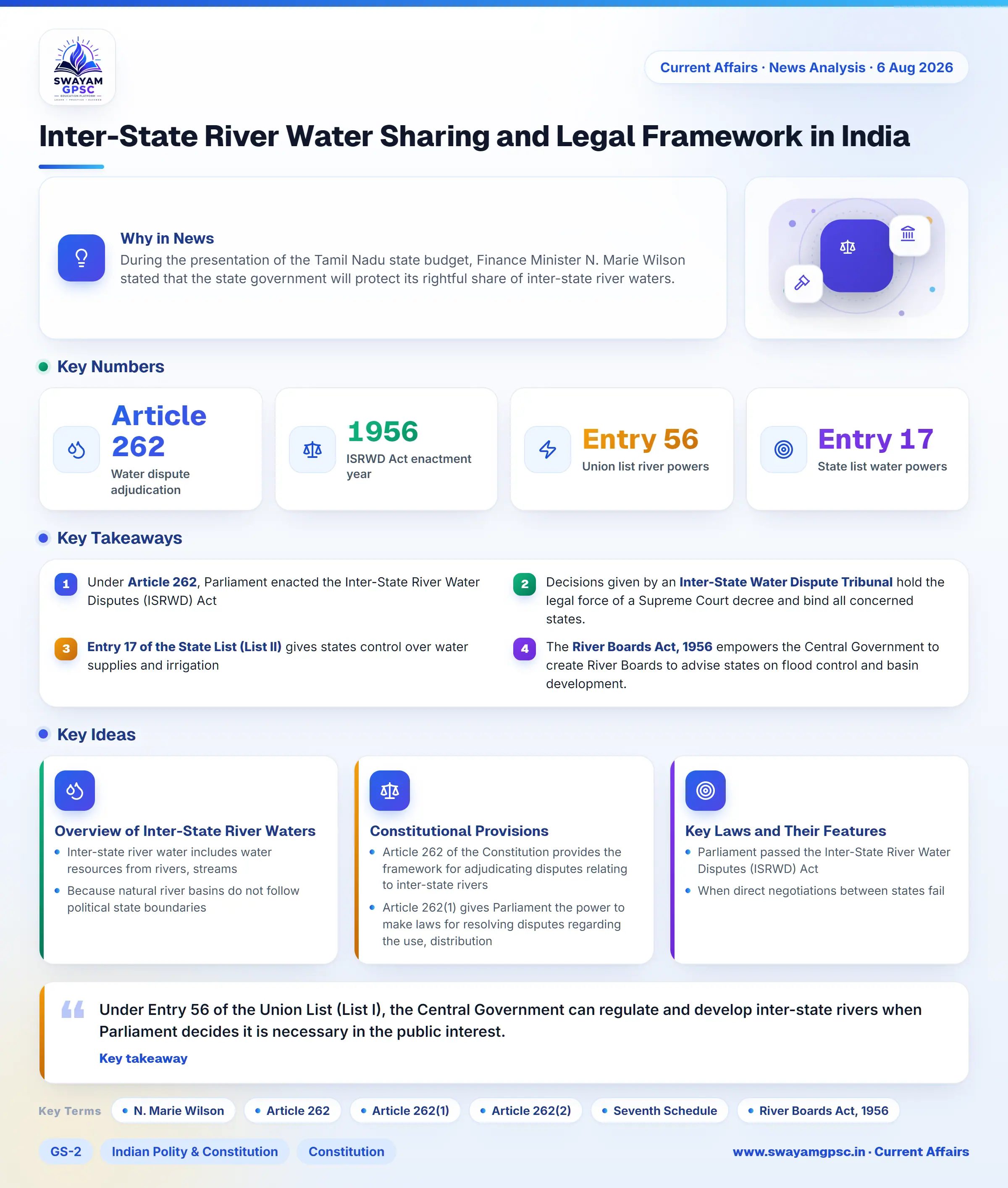
Inter-State River Water Sharing and Legal Framework in India
#GS-2 #Indian Polity & Constitution #Constitution #Federalism #Inter-State Water Disputes #GS-3 #Current Events #National
Key takeaways
- Under Article 262, Parliament enacted the Inter-State River Water Disputes (ISRWD) Act, 1956 to resolve water sharing conflicts between states.
- Decisions given by an Inter-State Water Dispute Tribunal hold the legal force of a Supreme Court decree and bind all concerned states.
- Entry 17 of the State List (List II) gives states control over water supplies and irrigation, while Entry 56 of the Union List (List I) gives the Centre power over inter-state rivers.
- The River Boards Act, 1956 empowers the Central Government to create River Boards to advise states on flood control and basin development.
Why in News
- During the presentation of the Tamil Nadu state budget, Finance Minister N. Marie Wilson stated that the state government will protect its rightful share of inter-state river waters.
Overview of Inter-State River Waters
- Inter-state river water includes water resources from rivers, streams, and river valleys that flow across or create boundaries between two or more states.
- Because natural river basins do not follow political state boundaries, managing and sharing these water resources requires inter-state coordination and federal dispute resolution systems.
Constitutional Provisions
- Article 262 of the Constitution provides the framework for adjudicating disputes relating to inter-state rivers and river valleys.
- Article 262(1) gives Parliament the power to make laws for resolving disputes regarding the use, distribution, or control of inter-state waters.
- Article 262(2) allows Parliament to restrict the Supreme Court or any other court from exercising jurisdiction over these river water disputes.
- Under the Seventh Schedule, Entry 17 of the State List (List II) covers water supplies, irrigation, canals, drainage, and water storage, subject to central laws.
- Under Entry 56 of the Union List (List I), the Central Government can regulate and develop inter-state rivers when Parliament decides it is necessary in the public interest.
Key Laws and Their Features
- Parliament passed the Inter-State River Water Disputes (ISRWD) Act, 1956 under Article 262 to handle water conflicts between states.
- When direct negotiations between states fail, the Central Government forms an ad-hoc Inter-State Water Dispute Tribunal to settle the issue.
- A decision given by this Tribunal holds the same legal weight as a Supreme Court order and binds all states involved in the dispute.
- The law prevents regular courts, including the Supreme Court, from hearing appeals against decisions made by the Tribunal under standard jurisdiction.
- Parliament enacted the River Boards Act, 1956 under Entry 56 of the Union List to support the regulation and growth of inter-state river basins.
- This law permits the Central Government to establish River Boards either on its own initiative or when state governments request one.
- These River Boards act as advisory bodies to guide states on river basin planning, flood management, soil conservation, and irrigation development.