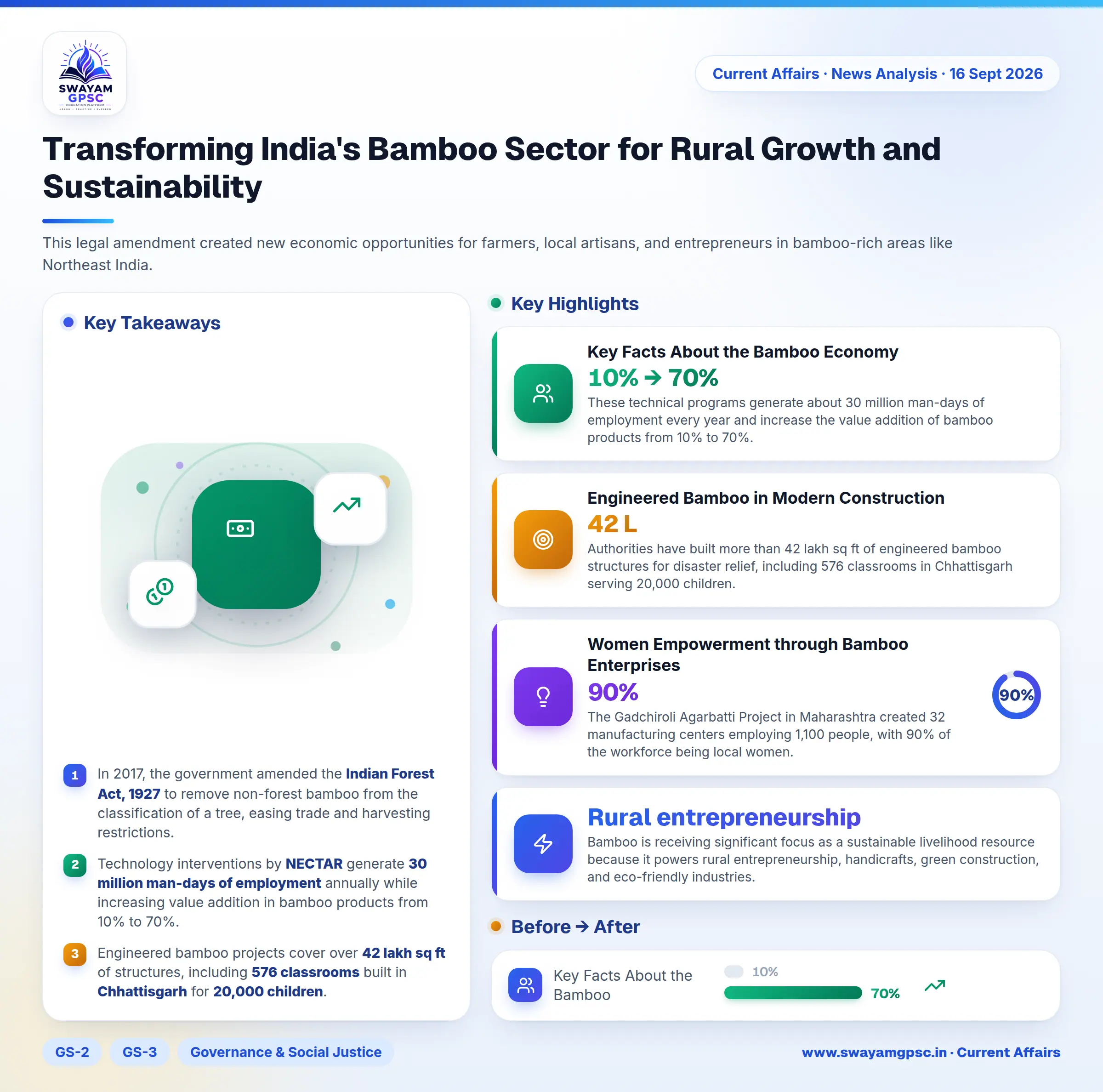
Transforming India's Bamboo Sector for Rural Growth and Sustainability
#GS-2 #GS-3 #Governance & Social Justice #Economy #Environment #Government Policies & Interventions #Agriculture #Employment #Sustainable Development #Women Empowerment
Key takeaways
- In 2017, the government amended the Indian Forest Act, 1927 to remove non-forest bamboo from the classification of a tree, easing trade and harvesting restrictions.
- Technology interventions by NECTAR generate 30 million man-days of employment annually while increasing value addition in bamboo products from 10% to 70%.
- Engineered bamboo projects cover over 42 lakh sq ft of structures, including 576 classrooms built in Chhattisgarh for 20,000 children.
- The Gadchiroli Agarbatti Project in Maharashtra operates 32 centers where 90% of workers are women, boosting their annual employment to over 225 days.
Why in News
- Bamboo is receiving significant focus as a sustainable livelihood resource because it powers rural entrepreneurship, handicrafts, green construction, and eco-friendly industries.
Key Facts About the Bamboo Economy
- Bamboo has traditionally supported rural and tribal communities by providing materials for handicrafts, building houses, and running small businesses.
- Under the British-era Indian Forest Act, 1927, bamboo was classified as a tree, which created strict regulatory hurdles for harvesting and transport.
- The government changed the law in 2017 by removing non-forest bamboo from the tree definition, which made private farming, harvesting, and trade much easier.
- This legal amendment created new economic opportunities for farmers, local artisans, and entrepreneurs in bamboo-rich areas like Northeast India.
- Farmers can plant bamboo to diversify their income because it acts as a long-term economic asset and allows growing other crops alongside it.
- An agency called NECTAR supports technology adoption in the bamboo sector across fields like food processing, building construction, machine manufacturing, and clean energy.
- These technical programs generate about 30 million man-days of employment every year and increase the value addition of bamboo products from 10% to 70%.
- Northeastern states like Tripura, Nagaland, Mizoram, and Sikkim actively promote bamboo products to boost tribal businesses and local job creation.
National Bamboo Mission (NBM)
- The central government launched the National Bamboo Mission (NBM) in 2006-07 and later restructured it in 2018-19 as a Centrally Sponsored Scheme.
- The mission uses a cluster-based approach to connect rural farmers directly with industrial buyers and urban consumer markets.
- To expand bamboo farming, the mission sets up new plant nurseries and improves existing ones so farmers can get high-quality seeds and saplings.
- The mission promotes bamboo handicrafts and markets bamboo as Green Gold to strengthen the rural bioeconomy.
Engineered Bamboo in Modern Construction
- Engineered bamboo is made by binding and compressing raw bamboo fibers into strong panels for modern building projects.
- Authorities have built more than 42 lakh sq ft of engineered bamboo structures for disaster relief, including 576 classrooms in Chhattisgarh serving 20,000 children.
- These projects prove that bamboo can move beyond traditional handicrafts into heavy construction and high-value industrial uses.
Capacity Building and Skill Development
- In June 2026, CSIR-NEERI in Nagpur conducted a five-day practical training workshop on bamboo handicrafts for women self-help groups.
- The training covered every step of the process, including harvesting, chemical treatment, product designing, branding, and final marketing.
- This training initiative also demonstrated how to cultivate bamboo on degraded fly-ash dump sites to restore ruined land into productive farmland.
Women Empowerment through Bamboo Enterprises
- Women self-help groups play a growing role in the bamboo supply chain by creating handicrafts and managing small factories.
- The Gadchiroli Agarbatti Project in Maharashtra created 32 manufacturing centers employing 1,100 people, with 90% of the workforce being local women.
- This incense-stick project increased annual work for participating women from 45-60 days to over 225 days, reducing their economic dependence on forest gathering.
- Running bamboo enterprises helps rural women build technical skills, earn steady wages, and take on leadership roles in their communities.
Botanical and Ecological Features of Bamboo
- Bamboo belongs to the Bambusoideae subfamily of the grass family Poaceae, spanning over 115 genera and 1,400 species mainly in tropical and subtropical regions.
- It is a fast-growing perennial plant with hollow stems, and under ideal conditions, some species can grow 30 cm per day and reach heights over 40 metres.
- Because bamboo flowers unpredictably, growers propagate it using stem cuttings, allowing the plant to regrow rapidly after every harvest.
- People often call bamboo poor man's timber due to its low cost, high strength, and wide range of everyday uses.
- Bamboo thrives best in warm climates with well-drained sandy or clay soils having a pH level between 4.5 and 6.0.
- Cultivating bamboo offers long-term income security for farming families through the sale of raw stems, furniture, and handicrafts.
- Data from the Forest Survey of India shows that major bamboo reserves are concentrated in Northeastern states like Assam, Arunachal Pradesh, and Manipur.
- Indigenous communities use bamboo extensively to build houses, craft musical instruments, weave baskets, and manufacture fishing gear.
Conclusion
- India's bamboo sector is shifting from traditional home crafts toward a modern green business ecosystem. Favorable policy changes, technical upgrades, and support for rural entrepreneurs are creating jobs and empowering rural women. Strengthening this supply chain will make bamboo a vital driver of India's sustainable economic development.