UPI Merchant Discount Rate (MDR) Framework 2026 Explained
#GS-3 #Economy #Banking #Mobilization of Resources #Infrastructure #Current Events
Key takeaways
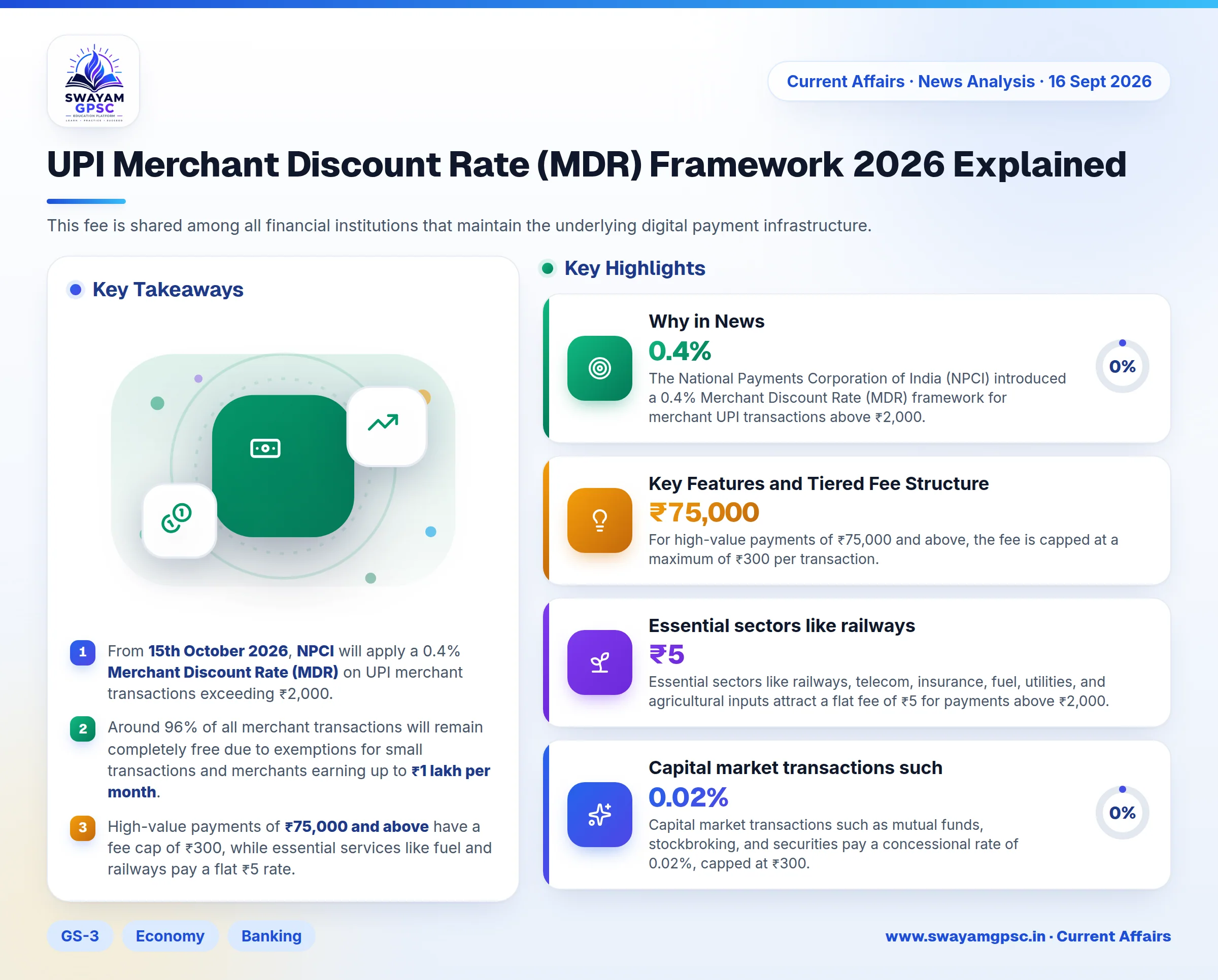
- From 15th October 2026, NPCI will apply a 0.4% Merchant Discount Rate (MDR) on UPI merchant transactions exceeding ₹2,000.
- Around 96% of all merchant transactions will remain completely free due to exemptions for small transactions and merchants earning up to ₹1 lakh per month.
- High-value payments of ₹75,000 and above have a fee cap of ₹300, while essential services like fuel and railways pay a flat ₹5 rate.
- A dedicated fund receiving 5% of total MDR collections will support digital payment expansion among small businesses.
Why in News
- The National Payments Corporation of India (NPCI) introduced a 0.4% Merchant Discount Rate (MDR) framework for merchant UPI transactions above ₹2,000.
- This new framework will take effect on 15th October 2026 under the Payment and Settlement Systems Act, 2007.
- The policy aims to make the UPI payment network self-sustaining while keeping regular daily payments completely free for common consumers.
Understanding Merchant Discount Rate (MDR)
- MDR is a service fee paid by merchants to banks, payment service providers, and UPI apps for processing digital payments.
- This fee is shared among all financial institutions that maintain the underlying digital payment infrastructure.
- MDR is not a government tax, and individual customers do not have to pay any extra charge on their purchases.
Key Features and Tiered Fee Structure
- Merchant payments up to ₹2,000 remain free, while transactions above ₹2,000 incur a standard 0.4% charge.
- For high-value payments of ₹75,000 and above, the fee is capped at a maximum of ₹300 per transaction.
- Essential sectors like railways, telecom, insurance, fuel, utilities, and agricultural inputs attract a flat fee of ₹5 for payments above ₹2,000.
- Capital market transactions such as mutual funds, stockbroking, and securities pay a concessional rate of 0.02%, capped at ₹300.
Exemptions and Protection for Small Merchants
- All Person-to-Person (P2P) transfers remain entirely free of cost, regardless of the money sent.
- Small merchants receiving up to ₹1 lakh per month through QR codes under the P2PM category pay zero MDR on all transactions.
- Recurring digital payments like UPI AutoPay mandates for bills and subscriptions are exempt from these charges.
- According to the Ministry of Finance, nearly 96% of all UPI merchant transactions will remain completely fee-free, with only 4% being affected.
Consumer Safeguards and Ecosystem Support
- The government instructed banks to ensure that merchants do not pass these MDR costs on to consumers.
- UPI payment applications are prohibited from introducing extra platform fees or hidden charges on transactions.
- A dedicated development fund will receive 5% of all collected MDR to expand digital payment infrastructure among small merchants.
Significance and Way Forward
- Introducing MDR provides payment service providers with a reliable revenue model, ensuring long-term financial stability.
- The collected funds will help extend digital payment networks into rural and semi-urban regions across the country.
- Maintaining free lower-value payments while collecting fees on larger transactions strikes a practical balance for digital growth.